 WhatsApp Us


Cognitive development in the early years has gone through various stages. Around 90% of a child's brain development occurs before age five, with about 80% of it formed by the age of three. This makes the early years from birth to the age of five a sensitive phase of cognitive growth. During this period, children's brains are highly responsive to experiences, interactions and environments.
Key Takeaways:
- Cognitive development progresses through recognised stages, but children move at different paces, with thinking shaped by experience, interaction and supportive environments.
- Early childhood is a sensitive period where play, exploration and relationships strongly influence memory, reasoning, attention and problem-solving abilities.
- Understanding Piaget's stages helps adults support learning realistically and value everyday experiences over formal instruction or pressure.
Cognitive development shapes how children learn, behave, and understand what is happening around them. It influences how they process information, respond to situations and develop habits that shape learning over time. These mental processes guide everyday behaviour from remembering routine to solving problems. This also helps progress across all areas of development.
Simple activities such as play, conversation and exploration have a lasting effect on how thinking skills form and strengthen. The quality of these early experiences often shapes a child's confidence, curiosity and approach to learning in later years.
What Is Cognitive Development in Early Childhood?
Cognitive development in early childhood is how children begin to think, remember, focus, reason and solve problems as they grow. It shapes their learning experience and helps them respond to new situations they will face in their everyday life.
As children play, explore and interact, their thinking becomes more organised. It strengthens their memory and focus and gradually improves their problem-solving skills. These mental skills develop together and link with other areas of growth.
Language helps children express their ideas and ask questions; physical movement supports exploration and discovery; and social interaction encourages learning through shared experiences. Early childhood is a critical period of brain development. This lays the groundwork for future learning, behaviour, and confidence.
The Main Stages of Cognitive Development in Early Childhood
Jean Piaget identified stages of cognitive development to describe how children's thinking changes as they grow. He proposed that children move through four broad stages of cognitive development as their thinking becomes more complex.
These are the sensorimotor, preoperational, concrete operational, and formal operational stages. Each stage reflects a change in how children understand information, solve problems and view the world. Children move through these stages in the same order, but the pace can vary.
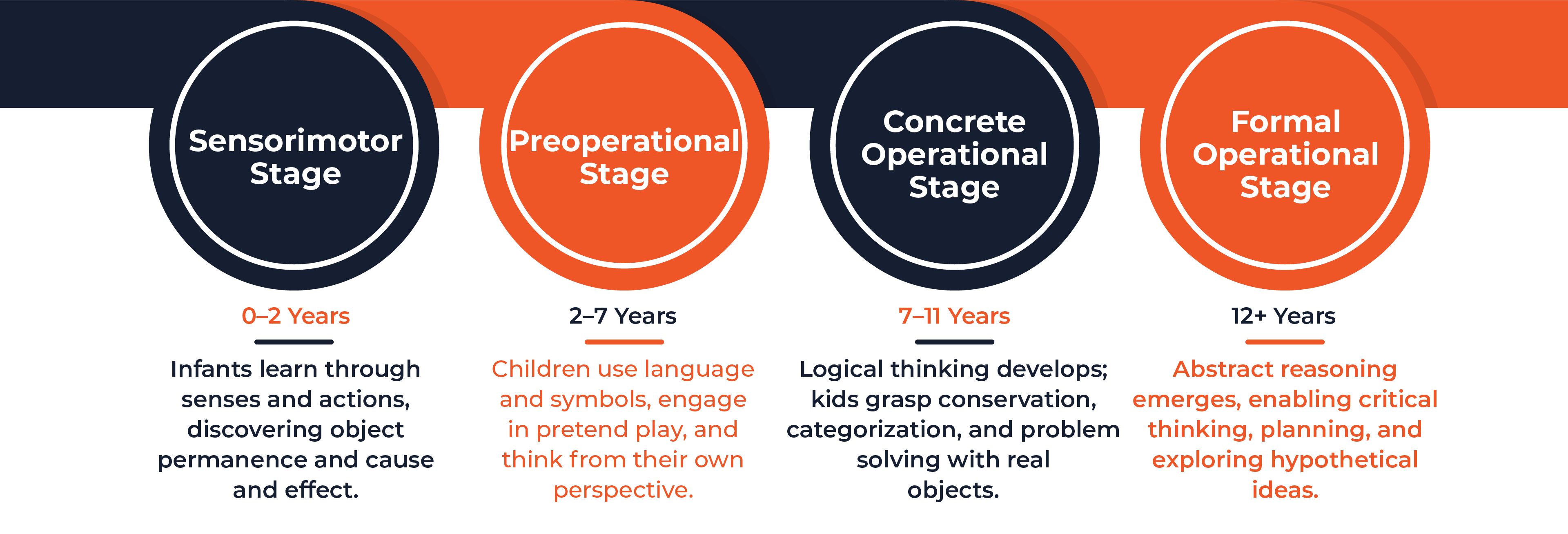
During the sensorimotor stage, infants learn primarily through physical actions and sensory experiences. Thinking is closely linked to movement, sight, sound and touch. Babies explore their surroundings by reaching, grasping, crawling and eventually walking. They begin to notice cause and effect through repeated action, such as shaking a toy to make a sound.
A key development at this stage is object permanence, in which children learn that objects continue to exist even when they cannot be seen. Learning often happens through trial and error, as children test actions and observe results. Simple grouping skills emerge, such as noticing similarities and differences. Babies start to recognise familiar faces, voices and daily routines. Their early memory starts to form.
Stage 2: Preoperational Stage (2 to 7 Years)In the preoperational stage, children begin to use language and symbols to represent ideas. Pretend play becomes more frequent, and children enjoy using objects to stand in for real things. Thinking is still centred on the child's own perspective. This makes it difficult for them to see situations from another person's point of view.
Early number ideas and time-related concepts begin to form. Reasoning at this stage is intuitive rather than logical. At this age, the attention spans of children improve. They can hold their focus for longer periods, and their memory becomes more reliable. Their questions become more focused and meaningful, showing deeper curiosity. These skills support early school readiness, including concentration, recall and decision-making.
Stage 3: Concrete Operational Stage (7 to 11 Years)At this stage, children develop more logical thinking. Their logic starts to link with real, tangible situations. They can organise information, sort objects into categories and understand concepts such as number, size and order more clearly.
Children at this stage begin to understand that quantity remains the same even when its appearance changes. Their memory and problem-solving skills improve, and their thinking becomes less self-centred. However, abstract ideas may still be challenging without physical examples
Stage 4: Formal Operational Stage (12 Years and Beyond)The formal operational stage marks the development of abstract thinking. Young people can now think beyond concrete experiences and consider ideas such as fairness, future possibilities and hypothetical situations. They are able to plan, reason logically and reflect on their own thinking.
Problem-solving becomes more systematic, and individuals can explore multiple solutions before making decisions. This stage supports higher-level learning, critical thinking and independent reasoning.
Are You Working Towards a Childcare Qualification?
Build your understanding in early-year education with us!
What is Piaget's View of Learning in Early Childhood?
Jean Piaget viewed children as active learners who build their own knowledge through experience. They test ideas and adjust their thinking based on what happens next. This process allows children to form their own meaning from everyday experiences.
Learning, in Piaget's view, happens through exploration, experimentation and interaction with the environment. Interaction with people and materials gives children the feedback they need to refine their thinking.
A three-year-old tries to fit a square block into a round hole. At first, they push harder, believing force will make it work. After several attempts, they pause, observe, rotate the block and eventually choose a different shape. No adult instruction was needed. The child learned through trial, observation and adjustment. This simple moment reflects Piaget's belief that mistakes are valuable steps in learning.
Piaget also stressed that developmental stages are guides rather than fixed rules. Children do not suddenly change the way they think. Their skills overlap, progress varies, and development is influenced by experience and environment. Understanding stages helps adults support learning appropriately.
How Can You Support Cognitive Development in Early Years Settings?
Supporting cognitive development in early years settings involves creating meaningful learning experiences that stimulate thinking, curiosity and problem-solving skills.
The checklist below offers simple, practical strategies that educators and caregivers can use daily to help children build strong foundations for future learning.
- Provide a safe and stimulating environment with age-appropriate toys, books, sensory items and learning materials.
- Encourage play-based learning through puzzles, building blocks, role play, science kits, natural materials and creative activities.
- Talk to children regularly, ask open-ended questions and encourage them to express their thoughts.
- Read stories daily to build vocabulary, listening skills and imagination.
- Introduce simple problem-solving activities, such as sorting, matching and counting games.
- Support curiosity by allowing children to explore, ask questions and try new experiences.
- Use songs, rhymes and repetition to strengthen memory and language development.
- Create routines that help children feel secure and understand patterns in their day.
- Encourage social interaction through group activities and cooperative play.
- Observe each child's interests and adapt activities to match their developmental stage and learning pace.
Conclusion
The stages of cognitive development help adults recognise how children think, learn and respond at different ages. These stages offer guidance rather than fixed expectations, acknowledging that children develop at different paces and in different ways. Early thinking skills grow through experience, interaction and supportive environments that respect each child’s individual progress. Flexibility, play and emotional security remain central to healthy cognitive growth. When adults create safe and responsive environments, they support strong thinking skills that form the foundation for lifelong learning.